
US Congress retains funding for NASA's participation in LISA mission — Ars Technica
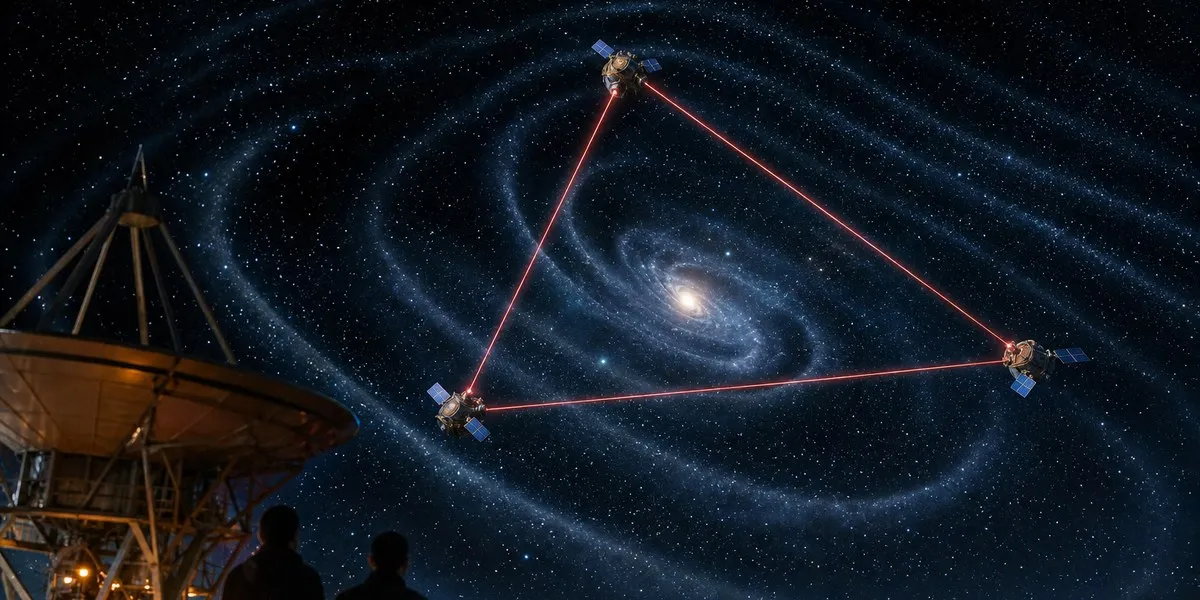
In the United States, Congress retained funding for NASA's participation in the European LISA mission in the budget for fiscal year 2026. The law, which President Donald Trump signed after congressional approval, is expected to signal Washington's support for the project to the European Space Agency, Ars Technica reports.
The Trump administration had previously proposed ending NASA's participation in LISA along with dozens of other scientific programs. Congress rejected the cut and restored funding for 2026, but the White House again proposed eliminating NASA's contribution in its budget request for fiscal year 2027.
A mission to search for gravitational waves
LISA is a planned space observatory for detecting and studying low-frequency gravitational waves. The mission is led by the European Space Agency, and the launch of three spacecraft in a triangular configuration into heliocentric orbit is planned for around 2035. The distance between the spacecraft will be about 2.5 million kilometers.
More current news is available on the UA.News Telegram channel Telegram.
NASA is to provide transmitters and telescopes for the laser system, instruments to control the electrical charge of the test masses, and support for data analysis on Earth. ESA will be responsible for building the spacecraft, launching them, and operating them. The expected cost of NASA's work is about $1 billion, although the agency has not yet approved a final budget commitment.
Scientific goals and cost sharing
ESA approved LISA's development in 2024 with a budget of €1.75 billion, or approximately $2 billion. This amount does not cover contributions from the United States and individual ESA member states. Ira Thorpe, head of the U.S. LISA science team, said that the United States pays for approximately one-third of the mission but will receive access to all scientific data.
The observatory is intended to study the origin of black holes and the formation of galaxies, as well as test Einstein's general theory of relativity. LISA will be more sensitive than ground-based detectors to lower-frequency gravitational waves, including those that may arise during mergers of supermassive black holes.


