
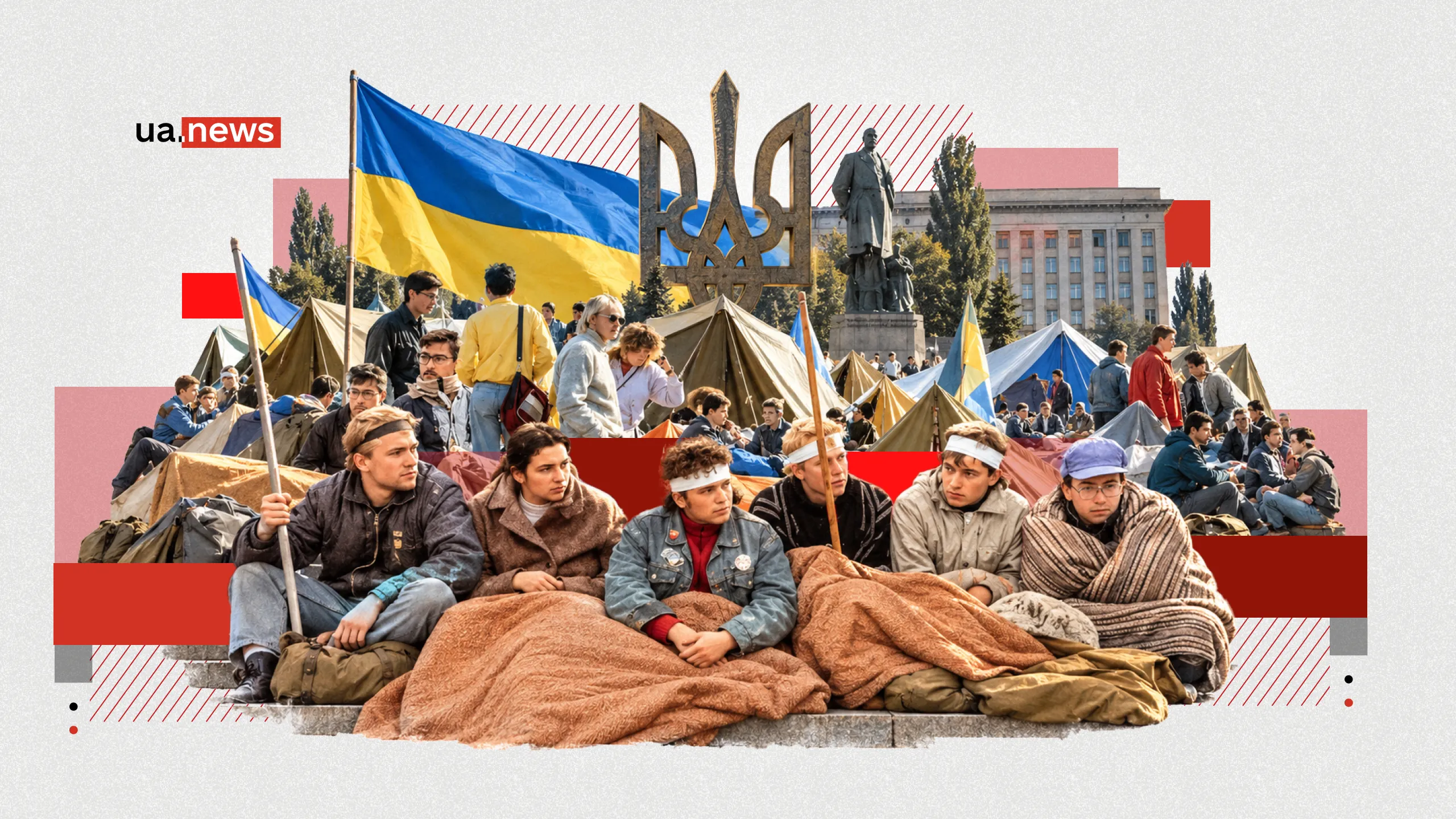
October 2 marks the 36th anniversary of the start of the Revolution on Granite. In 1990, on what was then October Revolution Square in downtown Kyiv, Ukrainian students set up tents, went on a hunger strike, and presented political demands to the Soviet authorities.
Within two weeks, the action had grown into a large-scale protest, joined by students, civic activists, lawmakers, and thousands of Kyiv residents. The young people demanded the resignation of Prime Minister Vitaly Masol, new parliamentary elections, rejection of the new Union Treaty, nationalization of Communist Party property, and military service for Ukrainian conscripts primarily within the republic.
At that time, less than 11 months remained until Ukraine’s declaration of independence. The Revolution on Granite demonstrated that an organized, nonviolent protest was already capable of forcing the Soviet authorities into negotiations and political concessions.
UA.News explains why Ukrainian students decided to go on a hunger strike in the fall of 1990, how the protest was organized, what they managed to achieve, and why the Revolution on Granite came to be regarded as one of the precursors to the Ukrainian Maidans.
The Soviet Union Was Already Beginning to Fall Apart
The Revolution on Granite did not arise out of thin air. In the late 1980s, the Soviet Union was experiencing simultaneous economic, political, and ideological crises. Mikhail Gorbachev’s policy of perestroika was intended to renew the system, but instead it exposed problems that had been concealed for decades by censorship and the repressive apparatus.
Glasnost made it possible to speak publicly about the Holodomor, political repression, Russification, the Chernobyl disaster, and other topics that had previously been effectively banned. Civil society organizations and political movements began to emerge that were no longer controlled by the Communist Party.
At the same time, the Soviet bloc in Central and Eastern Europe was collapsing. In Poland, representatives of “Solidarity” came to power; in the fall of 1989, the Berlin Wall fell; and regimes changed in Czechoslovakia, Bulgaria, and Romania. The example of neighboring countries demonstrated that the communist system was no longer unshakable.
In Ukraine, one of the main symbols of change was the election to the Supreme Council of the Ukrainian SSR in March 1990. For the first time, these elections were held on a competitive basis, and although the communists retained a majority, a democratic opposition—the People’s Council—formed in parliament.
Even more significant was the Declaration on the State Sovereignty of Ukraine, which the Verkhovna Rada adopted on July 16, 1990. The document proclaimed the supremacy of Ukrainian laws, the right to its own armed forces, economic independence, and other elements of future statehood. In practice, however, Ukraine remained part of the USSR. Moscow was drafting a new Union Treaty intended to reform the Soviet state and establish a new framework for relations between the republics.
For a significant portion of Ukrainian youth, this meant the risk that the proclaimed sovereignty would remain merely a declaration. That is why student organizations demanded not a gradual reform of the Union, but much more radical political changes.
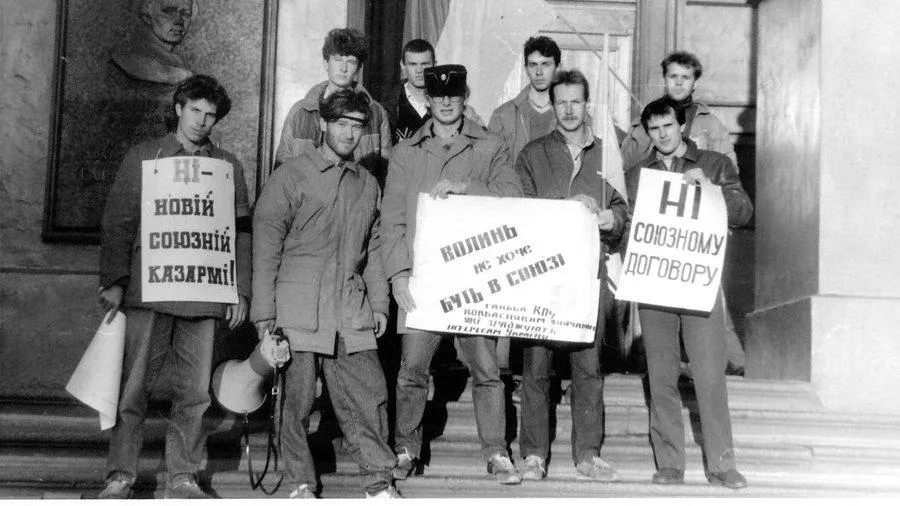
According to the Ukrainian Institute of National Remembrance, preparations for the upcoming protest began long before October 2. The main driving forces were the Ukrainian Student Union and the Lviv Student Brotherhood, whose activists already had experience organizing protests and political campaigns.
The protest was organized almost in secret
The organizers understood that the authorities might try to stop the protest before it even began. Therefore, preparations were carried out cautiously, and students from Lviv were sent to Kyiv in small groups so as not to attract undue attention from law enforcement.
They bought tickets in small batches, participants traveled via different routes, and only a limited circle of people knew the details of the upcoming protest. Initially, the protest was planned to take place closer to the Verkhovna Rada, but the government district was under police control. As early as September 11, parliament had banned mass gatherings within a one-kilometer radius of the Verkhovna Rada building. Therefore, the protest took place on October Revolution Square—a vast open space in the very heart of Kyiv.
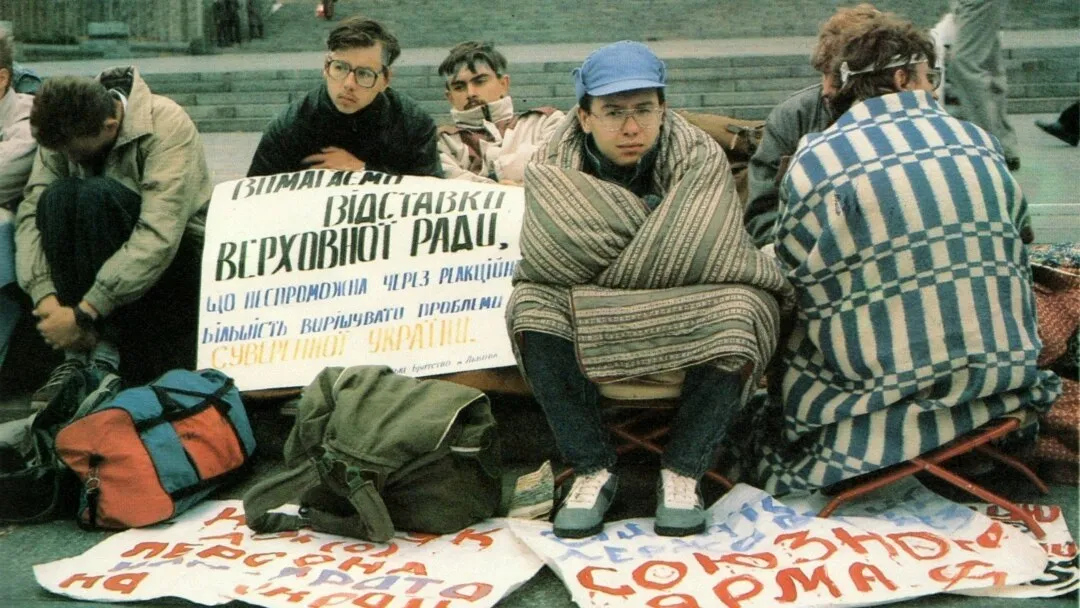
On October 2, students laid out mattresses and sleeping bags on the granite slabs, set up the first tents, and declared a hunger strike. It was precisely because of the square’s granite slabs that the protest later came to be known by the name by which it went down in history. Oles Doniy, Markiyan Ivashchyshyn, and Oleg Barkov became the co-chairs of the protest. A management system was quickly established within the camp. A Coordination Council was in place, along with security, a medical service, a press center, and teams responsible for logistical matters and public relations.
This level of organization was critically important. The hunger strike lasted many days, and the condition of some participants was deteriorating, so medical personnel regularly monitored their health. At the same time, it was necessary to maintain order in the camp and prevent provocations. A broader circle of support gradually formed around the students. Kyiv residents brought warm clothes, helped the protesters, and came to the square simply to talk with them. Cultural figures, including Lina Kostenko and Nila Kryukova, visited the students.
Gradually, the square ceased to be merely a place where a few dozen people were on a hunger strike. It became a political hub where the country’s future was discussed daily.
The students’ five demands concerned the future of all of Ukraine
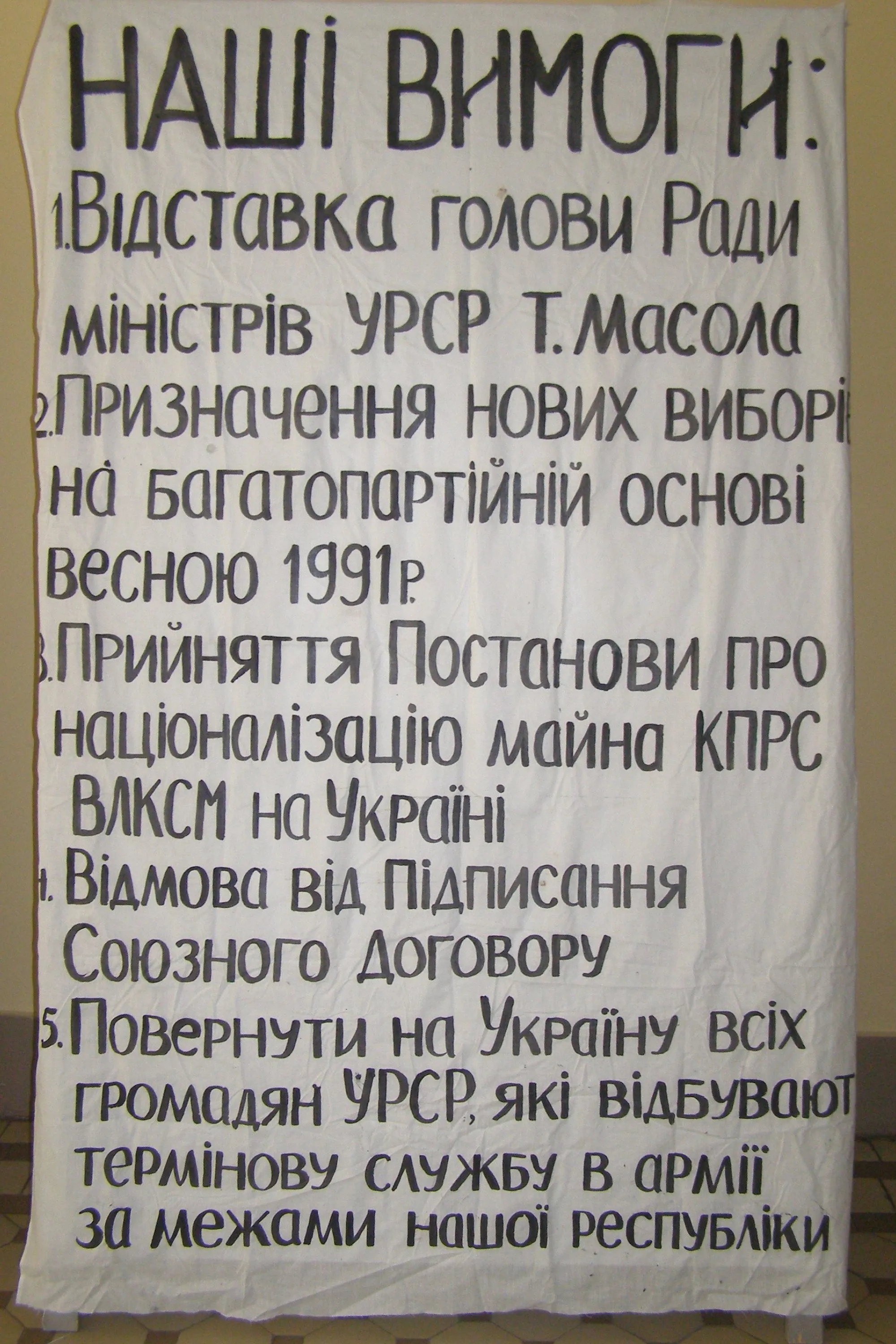
A distinctive feature of the Revolution on Granite was that its participants made almost no social or purely student-related demands. Virtually all of the main demands were political. One of them was the resignation of Vitaly Masol, Chairman of the Council of Ministers of the Ukrainian SSR. To the students, he embodied the old Soviet system of governance and the authorities’ unwillingness to implement changes quickly enough.
The second demand concerned the holding of new parliamentary elections on a multiparty basis. The Verkhovna Rada had been elected only a few months earlier, but the Communists continued to control the majority in it.
The students also demanded the nationalization of the property of the Communist Party of Ukraine and the Komsomol. For decades, these party structures had accumulated significant material resources, even though they were not formally state institutions.
The fourth demand was one of the most strategic—Ukraine was not to sign the new Union Treaty. It was this document that Moscow viewed as a way to preserve the USSR in a reformed form.
The final demand concerned military service. Ukrainian conscripts were to serve primarily within the republic. Against the backdrop of conflicts in various regions of the USSR, this issue was of great concern to thousands of families.
Taken together, these points effectively called the old Soviet model into question. Young people demanded a change in government, a reset of parliament, a weakening of the Communist Party, greater control over the army, and that Moscow not be allowed to bind Ukraine to the new Union.
That is precisely why the protest quickly ceased to be solely a student movement. Its demands resonated with the sentiments of a significant portion of the democratic opposition and of society, which had already witnessed the fall of communist regimes in neighboring countries.
The authorities initially expected the hunger strike to peter out on its own, but the protest only grew stronger
At first, the authorities were in no hurry to meet the demands. Their reasoning may have been quite simple: a few dozen young people would not be able to sustain a hunger strike for long, public interest would gradually wane, and the protest would eventually come to an end.
However, the opposite happened. News about the students spread more and more widely throughout Kyiv and other cities. More and more people gathered in the square, and students from other universities began organizing solidarity protests.
On October 9, negotiations took place between representatives of the Verkhovna Rada and the protesters. The next day, parliament refused to include the students’ demands on the agenda.
This decision did not stop the movement; it only radicalized it. Over the next few days, more and more Kyiv universities joined the protest. Rallies in support also took place outside the capital. October 15 proved to be a turning point, when a general student strike was declared in Kyiv. Young people began disrupting classes, entering university buildings, and calling on students to join the protest.
According to the Ukrainian Institute of National Remembrance, about 100,000 people—students, workers, and other citizens—gathered on the Maidan that day. The scale of the protest no longer allowed the authorities to treat it as a localized event.
Columns of protesters marched toward the Verkhovna Rada. Some demonstrators broke through the police cordon, after which another tent camp sprang up near the parliament building. In effect, within two weeks, the authorities found themselves facing a completely different situation: instead of a few dozen starving students in the center of the capital, they were confronted with a broad mass movement.
On October 17, the Verkhovna Rada agreed to a compromise
After the events of October 15, parliament could no longer simply ignore the protest. Student representatives were given the opportunity to participate in negotiations with lawmakers and to address the Verkhovna Rada directly. On October 17, a conciliation commission comprising lawmakers and representatives of the protesters agreed on the text of the resolution. The parliamentary transcript indicates that the parties reached a consensus on the draft resolution.
That same day, the Verkhovna Rada of the Ukrainian SSR adopted a resolution “On the Consideration of the Demands of Students Who Have Been on a Hunger Strike in Kyiv Since October 2, 1990.” The very fact that such a document was issued meant that the Soviet authorities were forced to officially respond to the youth movement’s ultimatum.
One of the most notable outcomes was the resignation of Vitaliy Masol. On October 23, the Verkhovna Rada voted separately to remove him from his post as Chairman of the Council of Ministers. An agreement was also reached regarding the performance of mandatory military service by Ukrainian citizens primarily within the republic, as well as political commitments regarding the protesters’ other demands.
Following the parliament’s decision, the students ended their hunger strike and began to dismantle their encampment. However, it would be an oversimplification to say that all five points were fully implemented. In particular, early parliamentary elections in the fall of 1991 never took place. The Verkhovna Rada, elected in 1990, continued its work even after independence was declared.
Nor was the demand for the complete nationalization of party property, as formulated by the protesters, immediately implemented. Therefore, the main outcome of the Revolution on Granite was not limited to specific parliamentary decisions. Far more important was the precedent it set: an organized, nonviolent protest demonstrated for the first time that even the Soviet authorities in Ukraine could be forced to back down.
The experience of the Revolution on Granite served as a model for future protests
In the fall of 1990, the collapse of the Soviet Union was not yet inevitable. Moscow was still trying to preserve the country through a new Union Treaty, communist structures remained strong, and Ukraine was formally one of the Soviet republics.
However, the student protest demonstrated just how rapidly society was changing. Young people, most of whom had no access to high-level politics, created their own organizational system, formulated specific demands, garnered public support, and forced parliament to negotiate with them.
Equally important was the fact that the protest was conducted using nonviolent methods. Tents, hunger strikes, strikes, marches, and mass gatherings in the central square proved to be sufficiently powerful tools of political pressure. Less than a year later, on August 24, 1991, the Verkhovna Rada declared Ukraine’s independence. On December 1 of that same year, over 90% of participants in the nationwide referendum supported the Act of Declaration of Independence.
The Revolution on Granite was not the sole cause of these events, nor did it single-handedly bring down the Soviet Union. However, it served as one indicator of just how far Ukrainian society had already moved away from the old Soviet political model.
It also left behind another important legacy—the very model of protest organization. The capital’s central square, the tent city, volunteer assistance, self-organized security, medical services, public outreach, support from city residents, and pressure on parliament—Ukraine would see many of these elements again during the Orange Revolution of 2004 and the Revolution of Dignity in 2013–2014.
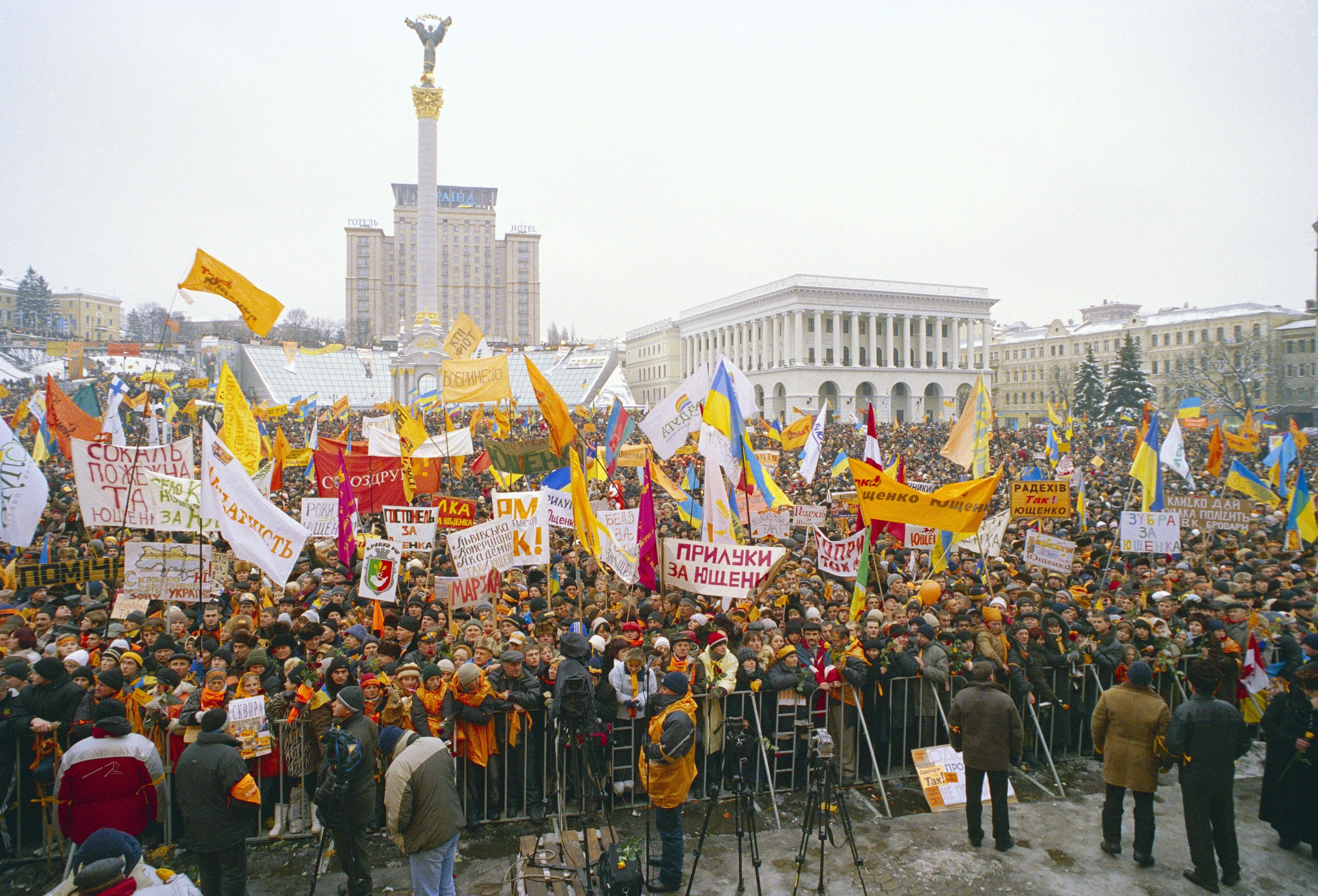
Even the location of the events became symbolic. In 1990, students went on a hunger strike in October Revolution Square. After independence was declared, it was renamed Independence Square.
That is precisely why the Revolution on Granite remains significant not only as a chapter in late Soviet history. It became one of the first major examples of how a tradition of public protest capable of actually influencing political decisions took shape in Ukraine.


