
Astronomers describe candidate for first known microblazar — Live Science
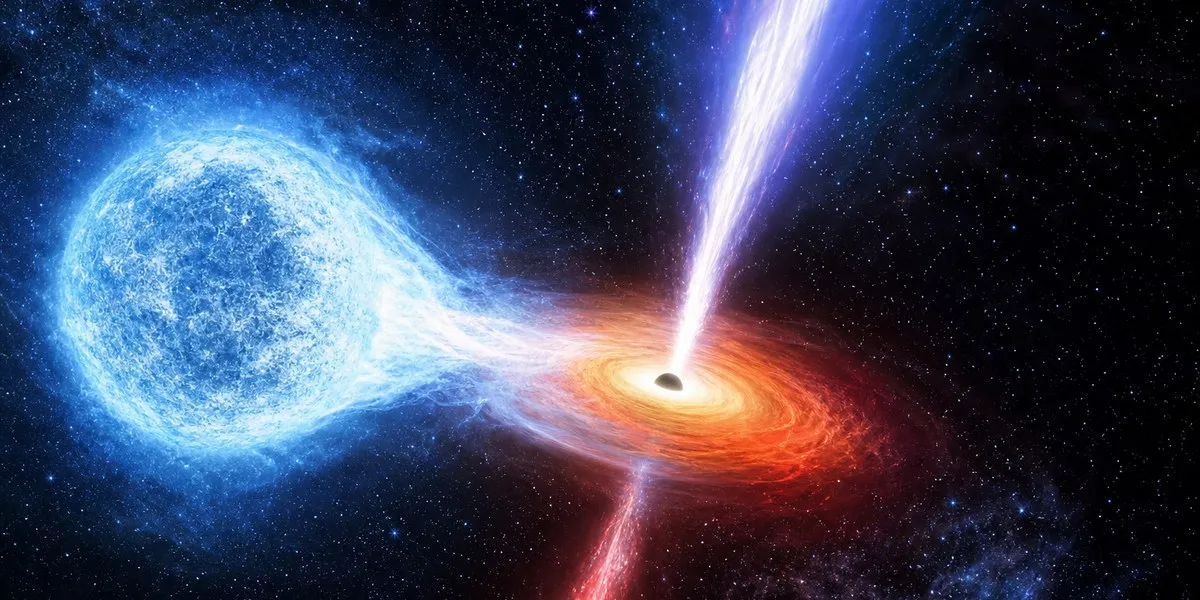
An international group of astronomers has described the object IRAS 18293-0941 as the most convincing candidate for a microblazar — a class of cosmic objects whose existence has long been predicted but has not yet been confirmed by observations. According to Live Science, the object is located in the Milky Way about 12,000 light-years from Earth and is hidden behind a veil of dust.
A binary system with a black hole
IRAS 18293-0941 is a binary system in which a black hole and a hot giant star orbit each other with a period of 11 days. Matter from the star falls into the black hole, while part of the material is ejected into the surrounding space in two oppositely directed jets of particles and radiation. The researchers concluded that one of these jets is directed toward Earth.
Blazars are among the most energetic objects in the Universe. They are a type of quasar in which a supermassive black hole consumes matter from its galaxy and ejects part of it in the form of two powerful jets of particles and radiation. An object is considered a blazar when one of its relativistic jets is aimed directly at Earth. Astronomers previously discovered smaller analogues of quasars — microquasars — while the existence of smaller analogues of blazars had only been assumed.
More current news is available on the UA.News Telegram channel Telegram.
Signs of the candidate
To observe IRAS 18293-0941, the study’s authors used the Calar Alto Observatory in Spain, the European Very Long Baseline Interferometry Network, the MeerKAT radio telescope array in South Africa, and archival data from the Very Large Array in the United States. They detected powerful emission in different regions of the electromagnetic spectrum and signs of the jets interacting with the surrounding environment.
At the same time, the object did not show the rapid brightness variations theoretically expected from microblazars. Such changes should be amplified by Doppler boosting when a jet is directed toward Earth. The study’s lead author, Josep Martí, suggested that a cloud of gas around the system may smooth out rapid brightness fluctuations. The researchers are also checking whether the region behind the object is a hot spot where the opposite jet heats the interstellar medium.


